Time for a "here's what we've been up to" post.
Hubby is on the road this week, doing some teaching and playing in South Dakota. I always look at these times as an opportunity to focus on neglected tasks. I can let the bedroom get even messier than usual while I create stacks and move them around. Time will tell if all that creating and moving leads to anything worthwhile.
Both of the college kids are earning bucks this summer. Caitlin is babysitting about 30 hours per week and Trevor is teaching with me at Sylvan and also doing some sub organ playing. They are both making great strides in their driving and hoping to get their licenses by summer's end. Yes, by today's standards they are old for getting drivers' licenses. It just hasn't been a priority for us, and with the craziness of life the past few years it was one of the things that got pushed aside. To kickstart the process we hired a driving instructor for some behind-the-wheel practice and now are just letting them drive as much as possible as we go hither and yon. I am getting to the point that I don't feel compelled to be a second set of eyes for them every second of every trip. Progress!
Evan has been taking swimming since early May and is also making great progress. He is counting the days until he goes to Lutheran summer camp next week. I have still not quite figured out how my Highly Sensitive Child who is deathly afraid of bugs and hates to be in wet or dirty clothes does so well at summer camp, but he does. He would go for more than one week per summer if we could afford it. This time he is going with one of his best friends from church, so he is even more excited as it is his friend's first time at camp, allowing him to be the experienced camper. I am so thankful for this opportunity for him.
Allergies have been horrible, just horrible, with symptoms of such severity that they make me feel ill. It was bad this time last year, too. I am loading up on OTC medications and hunkering down until it passes. For many years in Illinois I was on allergy shots but quit them when we moved. I may have to revisit immunotherapy but right now don't want to invest the time or money.
I finished my re-read of Pride and Prejudice. I liked it better this time around, but I am still not a huge Jane Austen fan. I will not be going on to another any time soon.
I am finding it difficult to reset my shopping and laundry habits for the increased numbers in the house. Probably about the time I succeed in doing so, they will leave. Sigh. The summer is going by too quickly.
Showing posts with label Reading. Show all posts
Showing posts with label Reading. Show all posts
Friday, June 12, 2015

Thursday, April 30, 2015
2015 Reading Challenge 4-Month Update

Since February, I have finished two more books and have another in progress. Looking for Alaska is done (I appreciated it, but didn't like it nearly as much as The Fault in Our Stars), as is LadyLike (previously unnamed mystery book). Moreover, a review of LadyLike has been written, submitted and accepted by Touchstone magazine! I think it will be published in the July/August issue. (Woot.)
I am now reading Pride and Prejudice, one of the re-reads on the list. It is one of those books I read years ago because as an English major I needed to. I didn't particularly enjoy it at the time. This time around is going better--I am understanding more the enthusiasm some of my friends have for Austen. But I still don't think I will ever be a huge fan.
All in all, I don't have quite as much to show for the last two months as I did in February. But it has been a very hectic time and summer is coming. I will need to pick up my pace to finish my list by the end of the year!
Saturday, February 21, 2015
2015 Reading Challenge Progress Report
Out of the original 23--
Three books finished, two in progress.
I think I'm on track. So far.
1. Unbroken, Hillenbrand. Already started.
2. Night, Elie Wiesel
3. The Failure of Sex Education in the Church, Bartlett
4. The Eternal Woman, Gertrud von le Fort - IN PROGRESS
5. The Seven Deadly Virtues, Hemingway et. al.
6. Orthodoxy, Chesterton
7. Studies in Words, C. S. Lewis
8. Glittering Images: A Journey Through Art from Egypt to Star Wars, Camille Paglia
9. My Bright Abyss, Christian Wiman
10. Bondage of the Will, Luther
Children's literature:
11. The Princess and the Goblin, MacDonald
12. The Marvelous Land of Snergs, Wyke-Smith.
Fiction:
13. Looking for Alaska, Green.
14. Les Miserables, Hugo. Backup plan if I hate Les Mis: Anna Karenina,Tolstoy. Backup plan if I hate Anna: nothing.
15. Alas, Babylon, Frank
16. Cry, the Beloved Country, Paton
17. The Martian Chronicles, Bradbury
18. Robinson Crusoe, Defoe
19. Pudd'nhead Wilson, Twain. Or maybe Roughing It. Something by Twain.
20. Lord of the Rings, Tolkien.
Rereads:
21. A Wrinkle in Time, L'Engle.
Unnamed:
23. TOTALLY AWESOME BOOK to which I have been given a pre-publication peek - IN PROGRESS
Three books finished, two in progress.
I think I'm on track. So far.
2. Night, Elie Wiesel
3. The Failure of Sex Education in the Church, Bartlett
4. The Eternal Woman, Gertrud von le Fort - IN PROGRESS
6. Orthodoxy, Chesterton
7. Studies in Words, C. S. Lewis
8. Glittering Images: A Journey Through Art from Egypt to Star Wars, Camille Paglia
9. My Bright Abyss, Christian Wiman
10. Bondage of the Will, Luther
Children's literature:
11. The Princess and the Goblin, MacDonald
12. The Marvelous Land of Snergs, Wyke-Smith.
13. Looking for Alaska, Green.
14. Les Miserables, Hugo. Backup plan if I hate Les Mis: Anna Karenina,Tolstoy. Backup plan if I hate Anna: nothing.
15. Alas, Babylon, Frank
16. Cry, the Beloved Country, Paton
17. The Martian Chronicles, Bradbury
18. Robinson Crusoe, Defoe
19. Pudd'nhead Wilson, Twain. Or maybe Roughing It. Something by Twain.
20. Lord of the Rings, Tolkien.
Rereads:
Unnamed:
23. TOTALLY AWESOME BOOK to which I have been given a pre-publication peek - IN PROGRESS
Sunday, February 1, 2015
Random Thoughts for a Super Bowl Sunday

I think we'll turn on the game, but I don't know or care that much about it. I think I heard something about leaked balls and deflated commercials? Or maybe it was deflated balls and leaked commercials. Whatever. We'll sit by the fire, listen to the wind, and drink our hot buttered rum while looking at the screen every now and then. I hope all you sports fans enjoy, and I hope everyone's team wins. ;-)
I finished reading Unbroken. Wow. It truly did make the war in the Pacific come alive. What I can't stop thinking about is the fact that this was the story of only one man, one whose personal fame led to his having a book written and a movie made about him, but whose story is only one of tens of thousands of similar ones. I don't know how people who undergo trials such as the one portrayed in the book live to tell about them. The human will to survive is a remarkable thing.
I wondered, when we moved to Oklahoma, if I would miss the snow. I don't. I guess 20 years of it was enough. :-) (Meanwhile, both my college kids are getting a huge dose of it. Enjoy it while you can, my dears!)
My church body, the LCMS, is going through something. Five years ago we elected a new president and many of us were filled with hope that some of the troubling trends of the last few generations would have the brakes put on them. In fact they have. There are wonderful things going on and everywhere signs that doctrinal faithfulness has returned as our prime directive. In spite of that, a few are not satisfied, demanding that everything must be corrected now. I don't understand this mindset from people who would not demand that a troubled parish change overnight. I have not always been Lutheran, and I don't pretend to understand all the history. But I have read and understood enough to know that we are heading in the right direction. I also understand that no human institution is ever going to be perfect. There is no such thing as complete purity when it comes to the practice of sinful human beings. Those who insist on such all-or-nothing purity had better be prepared to sit alone at a very tiny table with a very long spoon. I am content to continue walking together with brothers and sisters in Christ who may be taking smaller or larger steps, perhaps walking with a limp or a crutch, or even being pushed in a wheelchair, as long as we are headed in the same direction and led by a faithful and trustworthy leader. Regarding those who are intentionally trying to cause the confused or weak to stray, I agree that they should not be ignored or downplayed. But I have no reason, at this time, to doubt that those whose vocation it is to address such deceivers are doing so. My calling is to pray for and do my best to encourage them while waiting upon the Lord, who, I know, will guard His church.
Sometime in the near future I will have my ninth article published by The Federalist. I have also had one piece in American Thinker as well as one of my Federalist articles reprinted in the LCMS publication Notes for Life. Sometimes I think maybe I'm going to actually keep wearing this writer's hat. Other times I am terrified that a big gust of wind is going to blow it off any day now and I'll never find it again. But at the moment I am talking with a friend about writing a book and for once it is actually possible to imagine it happening.
Looks like it's about time for the game. The fire is lit and my husband just handed me a warm mug. Guess I better start not watching. Have a great night!
P.S. I just realized that I don't have a tag for "sports" in my category list. Almost 8 years of blogging and no sports. A jock I am not.
Tuesday, January 6, 2015
2015 Reading Challenge
I can't believe I'm doing this. Seriously, I can't. In 2015 I will celebrate my eight-year blogiversary. In all that time, I have avoided any hint of anything remotely resembling a reading challenge. I have written here in the past about my struggles with reading. My former status as an English teacher notwithstanding, in the last 20 years (basically since becoming a mom) I have found it increasingly difficult to read material of serious length or depth, family readalouds excepted. I think the reasons are varied but primarily include motherhood-induced attention deficit as well as the advent of electronic communication and social media. Both have contributed to my declining ability to concentrate on anything at all for more than about thirty seconds, much less 350 pages.
The last few years, however, have seen an improvement in my ability to stick with and finish a book. I'm still not reading as much as I would like or as much as I used to, but I'm reading again. So against my better judgment I'm going to assign myself a reading list this year. Unlike some of my friends whose lists number 50 or more, I have decided to aim low: more than one book per month, but less than two. The list below consists of titles that have either been on my to-read list a long time or have been suggested or otherwise made known to me in the last few years. They are grouped by category.
Nonfiction:
1. Unbroken, Hillenbrand. Already started.
2. Night, Elie Wiesel
3. The Failure of Sex Education in the Church, Bartlett
4. The Eternal Woman, Gertrud von le Fort
5. The Seven Deadly Virtues, Hemingway et. al.
6. Orthodoxy, Chesterton
7. Studies in Words, C. S. Lewis
8. Glittering Images: A Journey Through Art from Egypt to Star Wars, Camille Paglia
9. My Bright Abyss, Christian Wiman
10. Bondage of the Will, Luther
Children's literature:
11. The Princess and the Goblin, MacDonald
12. The Marvelous Land of Snergs, Wyke-Smith. "I should like to record my own love and my children's love of E. A. Wyke-Smith's Marvellous Land of Snergs." - J. R. R. Tolkien
Fiction:
13. Looking for Alaska, Green.
14. Les Miserables, Hugo. Backup plan if I hate Les Mis: Anna Karenina, Tolstoy. Backup plan if I hate Anna: nothing.
15. Alas, Babylon, Frank
16. Cry, the Beloved Country, Paton
17. The Martian Chronicles, Bradbury
18. Robinson Crusoe, Defoe
19. Pudd'nhead Wilson, Twain. Or maybe Roughing It. Something by Twain.
20. Lord of the Rings, Tolkien. What can I say? Tried it many years ago, but didn't get through the first book. I am not a huge fan of fantasy. But so many of the people I love, love these books. I like the movies. I think I need to try the book(s) again.
In addition, 2015 is apparently the year of the re-read (who decides these things, anyway?) So to keep the reading gods happy, here are two re-reads, one that I loved and one I didn't.
21. A Wrinkle in Time, L'Engle. A childhood favorite.
22. Pride and Prejudice, Austen. I read it many years ago and didn't enjoy it enough to read any more Austen. But so many of my friends love Austen that I think I need to give Lady Jane another try. We always tell our kids they have to try the foods they don't like periodically because maybe their taste buds have changed. Well, maybe my reading taste has also changed. Or maybe I'll still not understand the passion some of you have for Austen. We'll see.
Also this year I will be getting my first ever review copy of a book! More on that later. And I hope to read my daughter's novel, but first she has to finish it. Disclaimer: I reserve the right to stop reading anything on this list if after giving it a fair chance I find it doesn't pull me in. Life is short. Books are aplenty. Reading should be a joy, not a chore. Besides, I'm not in school anymore and don't have to read anything I don't want to. So there.
Feel free to make suggestions for future reading lists, or additions to this list in case I get through it (miracles can happen!) and need more.
The last few years, however, have seen an improvement in my ability to stick with and finish a book. I'm still not reading as much as I would like or as much as I used to, but I'm reading again. So against my better judgment I'm going to assign myself a reading list this year. Unlike some of my friends whose lists number 50 or more, I have decided to aim low: more than one book per month, but less than two. The list below consists of titles that have either been on my to-read list a long time or have been suggested or otherwise made known to me in the last few years. They are grouped by category.
Nonfiction:
1. Unbroken, Hillenbrand. Already started.
2. Night, Elie Wiesel
3. The Failure of Sex Education in the Church, Bartlett
4. The Eternal Woman, Gertrud von le Fort
5. The Seven Deadly Virtues, Hemingway et. al.
6. Orthodoxy, Chesterton
7. Studies in Words, C. S. Lewis
8. Glittering Images: A Journey Through Art from Egypt to Star Wars, Camille Paglia
9. My Bright Abyss, Christian Wiman
10. Bondage of the Will, Luther
Children's literature:
11. The Princess and the Goblin, MacDonald
12. The Marvelous Land of Snergs, Wyke-Smith. "I should like to record my own love and my children's love of E. A. Wyke-Smith's Marvellous Land of Snergs." - J. R. R. Tolkien
13. Looking for Alaska, Green.
14. Les Miserables, Hugo. Backup plan if I hate Les Mis: Anna Karenina, Tolstoy. Backup plan if I hate Anna: nothing.
15. Alas, Babylon, Frank
16. Cry, the Beloved Country, Paton
17. The Martian Chronicles, Bradbury
18. Robinson Crusoe, Defoe
19. Pudd'nhead Wilson, Twain. Or maybe Roughing It. Something by Twain.
20. Lord of the Rings, Tolkien. What can I say? Tried it many years ago, but didn't get through the first book. I am not a huge fan of fantasy. But so many of the people I love, love these books. I like the movies. I think I need to try the book(s) again.
In addition, 2015 is apparently the year of the re-read (who decides these things, anyway?) So to keep the reading gods happy, here are two re-reads, one that I loved and one I didn't.
21. A Wrinkle in Time, L'Engle. A childhood favorite.
22. Pride and Prejudice, Austen. I read it many years ago and didn't enjoy it enough to read any more Austen. But so many of my friends love Austen that I think I need to give Lady Jane another try. We always tell our kids they have to try the foods they don't like periodically because maybe their taste buds have changed. Well, maybe my reading taste has also changed. Or maybe I'll still not understand the passion some of you have for Austen. We'll see.
Also this year I will be getting my first ever review copy of a book! More on that later. And I hope to read my daughter's novel, but first she has to finish it. Disclaimer: I reserve the right to stop reading anything on this list if after giving it a fair chance I find it doesn't pull me in. Life is short. Books are aplenty. Reading should be a joy, not a chore. Besides, I'm not in school anymore and don't have to read anything I don't want to. So there.
Feel free to make suggestions for future reading lists, or additions to this list in case I get through it (miracles can happen!) and need more.
Friday, January 2, 2015
Of Monsters and Angels

At the suggestion of several people whose opinions I respect, I recently read Neil Gaiman's The Ocean at the End of the Lane. I have never read any of Gaiman's work before and wasn't sure what to expect. Initially I thought the book was going to be a psychological drama with an element of mystery but it didn't take long to realize that what I was reading instead was a no-holds barred fairy tale for adults. I wouldn't call the book an allegory, but if you enjoy allegory, fantasy, and tales with supernatural elements, I would recommend it. It is a fairly quick and easy read. I hasten to add that while several reviews I read suggested it is suitable for all ages, I strongly disagree. It is one very scary book, and there are several scenes that are definitely not appropriate for children.
I should clarify what I mean in calling the book easy to read. It is limited in narrative scope, focusing on a few characters primarily at a single point in time and space, and it is straightforwardly told. So it is easy in the storytelling sense. It is not, however, easy to pinpoint the book's meaning, and as a one-time English major I like to be able to do just that. So ever since I finished reading I have been trying to figure out what it all means, and here in non-spoiler fashion is what I have concluded (at least for now).
One of my favorite parts of the book occurs when the main character/narrator, who is seven years old at the time, has a conversation about monsters with his 11-year-old friend. (Monsters figure prominently in the book.) As they discuss the nature of monsters, Lettie, the 11-year-old, observes:
"Monsters come in all shapes and sizes. Some of them are things people are scared of. Some of them are things that look like things people used to be scared of a long time ago. Sometimes monsters are things people should be scared of, but they aren't."
The conversation between the two continues as they discuss one of the adult characters whose behavior has been nothing short of monstrous:
I said, "People should be scared of Ursula Monkton."
"P'raps. What do you think Ursula Monkton is scared of?"
"Dunno. Why do you think she's scared of anything? She's a grown-up, isn't she? Grown-ups and monsters aren't scared of things."
"Oh, monsters are scared," said Lettie. "That's why they're monsters. And as for grown-ups . . . . I'm going to tell you something important. Grown-ups don't look like grown-ups on the inside either. Outside, they're big and thoughtless and they always know what they're doing. Inside, they look just like they always have. Like they did when they were your age. The truth is, there aren't any grown-ups. . . . "
In my opinion this passage encapsulates what the book is about. As the story opens the narrator is an adult returning to the town of his childhood to attend a funeral; he is soon overtaken by the repressed memory of something terrible that happened when he was seven years old. The bulk of the book recounts that memory, which includes an epic battle against some pretty horrifying creatures. Therein lies the heart of the book. Throughout our lives we encounter monsters in various shapes and sizes. Sometimes they look like monsters; sometimes they don't. Sometimes we recognize them; sometimes we don't. But they are there, and in one way or another we are always battling them. If we are lucky we will have someone on our side helping us fight them. But we will always bear the scars of the various monsters we encounter, and it may take a long time for those scars to heal. Moreover, even when the battle is over and we have moved on, the memories have a way of calling us back and making us relive the entire ordeal. That is to be expected and is a necessary part of processing what has happened. That battle with the monster was real, and pretending it wasn't doesn't help. Acknowledging and facing it is part of the process of healing and moving on.
I am a Christian and as such tend to read everything through the lens of my faith. Neil Gaiman is not a Christian as far as I know, and neither is his book, but there are several themes in the book that rang true for me as a Christian. There is no doubt in this book that there is such a thing as evil and such a thing as good and that they are at war with each other in big and small ways. There is no doubt that there is more to the created world than what we see on the surface. And perhaps most important, there is something called love, and it is so powerful that it can lead one to sacrifice himself for the sake of another.
Here are a few more takeaways from the book that rang especially true for me:
Monsters are real, but they don't always look like what you might expect.
The same goes for angels.
Sometimes the people you most trust turn out to be monsters.
The monsters are afraid, too. Sometimes they don't even know they're monsters. They may even think they're doing good.
Help can come from the most unexpected places.
There is such a thing as evil. It is powerful, but good is more powerful.
Things are not always as they seem.
Much of life doesn't make sense, but every once in a while we are granted a moment of clarity, and it can strengthen us for the rest of the journey.
If you're looking for a book to get lost in for a few days, one that will capture your imagination and get you thinking about some of the Big Questions, you could do worse than The Ocean at the End of the Lane.
Wednesday, October 22, 2014
Last Lasts
Yesterday on Facebook I saw this.
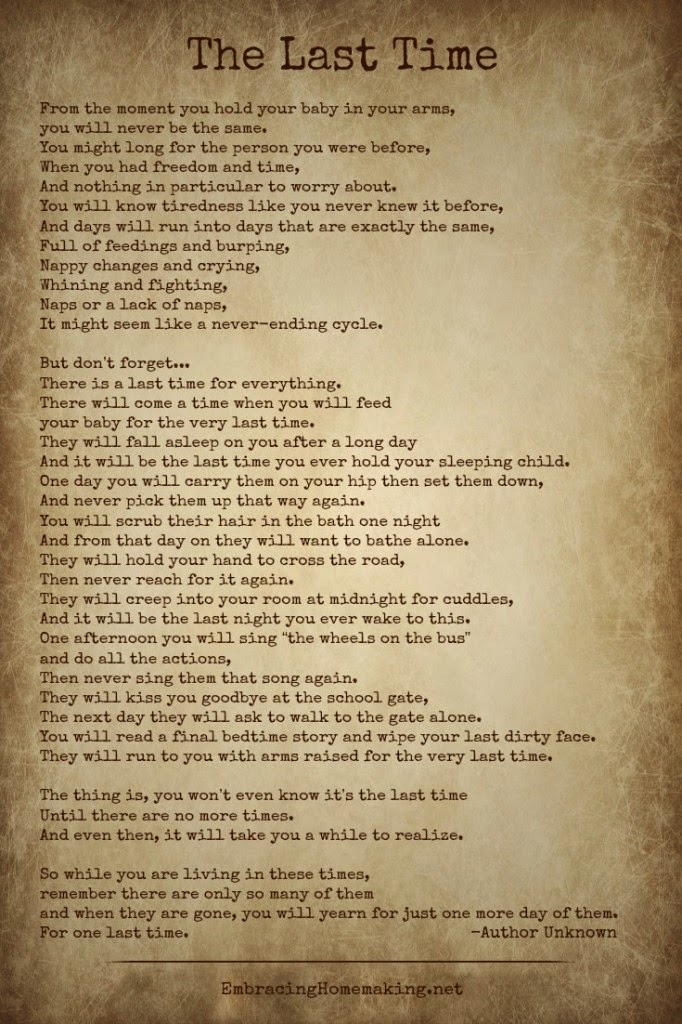
It reminded me of a blog post I wrote a few years ago along the same lines. As parents we experience countless "lasts" with our children. Sometimes we know going in that it's the last time; sometimes we don't. Sometimes the "last" is a momentous event (graduation, confirmation); other times it's trivial (tying shoes or applying a bandage). Sometimes, while it's the last time for one child, we know there are others waiting in the wings to do the same thing. But if we're on our last child, there are all sorts of lasts that are specific not only to him but that are the last time we'll do that thing with any of our children, ever.
Yesterday something that came up in a conversation with Evan, my 10-year-old, prompted me to start reciting from the book One Fish, Two Fish, Red Fish, Blue Fish by Dr. Seuss. How many times I have read that book over the years, starting with Trevor (now 22), then with Caitlin (now 19), and finally with Evan. It has to have been hundreds! No wonder I can still recite large portions of it from memory. Sometimes when I do I can hear in my head the exact way it sounded on my children's lips. So it was a sweet and serendipitous surprise last night when Evan asked not only if we could read the book at bedtime, but if he could read it to me. (I am really glad my 10-year-old still likes Dr. Seuss.) We sat together, and he read, and we laughed, and I remembered. . . . and wondered whether this was another last last.

It reminded me of a blog post I wrote a few years ago along the same lines. As parents we experience countless "lasts" with our children. Sometimes we know going in that it's the last time; sometimes we don't. Sometimes the "last" is a momentous event (graduation, confirmation); other times it's trivial (tying shoes or applying a bandage). Sometimes, while it's the last time for one child, we know there are others waiting in the wings to do the same thing. But if we're on our last child, there are all sorts of lasts that are specific not only to him but that are the last time we'll do that thing with any of our children, ever.
Yesterday something that came up in a conversation with Evan, my 10-year-old, prompted me to start reciting from the book One Fish, Two Fish, Red Fish, Blue Fish by Dr. Seuss. How many times I have read that book over the years, starting with Trevor (now 22), then with Caitlin (now 19), and finally with Evan. It has to have been hundreds! No wonder I can still recite large portions of it from memory. Sometimes when I do I can hear in my head the exact way it sounded on my children's lips. So it was a sweet and serendipitous surprise last night when Evan asked not only if we could read the book at bedtime, but if he could read it to me. (I am really glad my 10-year-old still likes Dr. Seuss.) We sat together, and he read, and we laughed, and I remembered. . . . and wondered whether this was another last last.
Monday, July 14, 2014
Trying to Nurture a Reader
My first and second born children were bookworms from the get-go. I never had to encourage them to read; they just did it. Number three is different. He was an early reader like his siblings, and he reads well and fluently, but he doesn't love it like they did. My daughter thinks he might simply be wired differently; I do think that is true but can't help also wondering if his different reading habits are at least partly attributable to the effect his birth order has had on my parenting and homeschooling of him. (Sigh--I'm older and tireder than I was with the first two.)
I suppose at this point cause is of little consequence. He is the reader he is, which means that for the last few years I have been trying to find books that will hook him to the point that he reads of his own volition, not because it is assigned (he will obediently read when I make him). I long to see him get lost in a book the way I used to, such that the outside world fades from view and the book completely captures his imagination for an afternoon, day, or week. Over the years there are a few things that have done that for him; I have listed below the ones I can think of right now.
Calvin & Hobbes, Garfield, Peanuts and vintage Archie comics
Newspaper funnies
Video game strategy guides
Magic School Bus series
Wayside School series
Encyclopedia Brown mysteries
Rush Revere series
This past week I took a chance and ordered a used set of the first five Hardy Boys books--the classic, not updated, ones. He is currently enjoying the first one, but it remains to be seen whether he will choose to read another. Some other series that have already been tried and rejected are Magic Tree House, Redwall, and Percy Jackson (we tried Percy Jackson because for a while he was enjoying reading D'aulaires' Book of Greek Myths, and he enjoyed it at first, but I think it was ultimately too intense for my HSC*). He does like the Narnia books, but maybe because he has seen the movies (?) he tends to read them in bits and pieces, skipping around, instead of sitting down and reading from cover to cover. So we just started The Magician's Nephew as a readaloud in the hope that maybe it will spark him to continue through the series in order.
Reflecting on all of this, I guess we are not doing so bad. I know there are parents who would be glad to see their children reading as much as my 10-year-old. I am just used to kids who read more! Perhaps I should not compare him to his siblings. But before he is beyond my influence I hope I can help him more fully experience the joy of reading. If you can comment with either commiseration or advice, please do!
*Highly sensitive child
I suppose at this point cause is of little consequence. He is the reader he is, which means that for the last few years I have been trying to find books that will hook him to the point that he reads of his own volition, not because it is assigned (he will obediently read when I make him). I long to see him get lost in a book the way I used to, such that the outside world fades from view and the book completely captures his imagination for an afternoon, day, or week. Over the years there are a few things that have done that for him; I have listed below the ones I can think of right now.
Calvin & Hobbes, Garfield, Peanuts and vintage Archie comics
Newspaper funnies
Video game strategy guides
Magic School Bus series
Wayside School series
Encyclopedia Brown mysteries
Rush Revere series
This past week I took a chance and ordered a used set of the first five Hardy Boys books--the classic, not updated, ones. He is currently enjoying the first one, but it remains to be seen whether he will choose to read another. Some other series that have already been tried and rejected are Magic Tree House, Redwall, and Percy Jackson (we tried Percy Jackson because for a while he was enjoying reading D'aulaires' Book of Greek Myths, and he enjoyed it at first, but I think it was ultimately too intense for my HSC*). He does like the Narnia books, but maybe because he has seen the movies (?) he tends to read them in bits and pieces, skipping around, instead of sitting down and reading from cover to cover. So we just started The Magician's Nephew as a readaloud in the hope that maybe it will spark him to continue through the series in order.
Reflecting on all of this, I guess we are not doing so bad. I know there are parents who would be glad to see their children reading as much as my 10-year-old. I am just used to kids who read more! Perhaps I should not compare him to his siblings. But before he is beyond my influence I hope I can help him more fully experience the joy of reading. If you can comment with either commiseration or advice, please do!
*Highly sensitive child
Tuesday, May 6, 2014
Reading Challenge
Periodically one of my friends posts something online about taking part in a reading challenge. Such a challenge typically involves coming up with a list of books to read in a given period of time. There was a time I would have embraced so worthy a goal, but these days it sends me running in the opposite direction. You see, I don't like failure. Avoiding situations in which its occurrence is predestined is one of my basic guiding principles.
Still, I do believe in the value of reading, and by "reading" I mean "reading books." I worry that in our headline-driven, Twitter-dominated society, human beings, myself included, are losing the ability to concentrate on complex ideas for extended periods of time. I also miss the joy I used to take in getting lost in a good book. So last year I created my own reading challenge, which goes something like this: "Pick out a book and read it."
You think I'm joking. I'm not. Right now, it's the best I can do. And for the most part, it's working for me. I've read more books over the last year than I've read over the last five years. I'm not going to tell you how many books that actually is.
Recently, though, I seem to have hit a snag. I have tried one book and another and nothing has grabbed me. So I finally did the obvious thing: I asked my daughter for a suggestion. She readily obliged, and I started the book she gave me a few nights ago night. At this writing I am ten chapters in.
The book is The Fault in Our Stars by John Green, one of Caitlin's favorite YA (Young Adult) authors. I am impressed. The story is engaging, and so is the first person narrator. But one of the things I am most appreciating is the style. For me style is as important as story. When it comes right down to it, plot lines can be reduced to a few essential arcs. People are born. They die. Along the way they do stuff. The greatness of a book is in the telling, in the ability to memorably and freshly cut to the truth of a situation in a way that makes you say, "Yes, that is exactly it." I am seeing this characteristic in abundance in The Fault in Our Stars. I am also meeting characters who are real and likable and intelligent. The book does not come across as one written for teenagers. It is devoid of clichés. It is a book about the human condition, and that is something that has no age limit. Here is an example that I think can be understood and appreciated without context or comment.
"She didn't want to dump a blind guy," I said. He nodded, the tears not like tears so much as a quiet metronome--steady, endless.
"She said she couldn't handle it," he told me. "I'm about to lose my eyesight and she can't handle it."
I was thinking about the word handle, and all the unholdable things that get handled. "I'm sorry," I said.
He wiped his sopping face with a sleeve. Behind his glasses, Isaac's eyes seemed so big that everything else on his face kind of disappeared and it was just these disembodied floating eyes staring at me--one real, one glass. "It's unacceptable," he told me. "It's totally unacceptable."
"Well, to be fair," I said, "I mean, she probably can't handle it. Neither can you, but she doesn't have to handle it. And you do."
"I kept saying 'always' to her today, 'always always always,' and she just kept talking over me and not saying it back. It was like I was already gone, you know? 'Always' was a promise! How can you just break the promise?"
"Sometimes people don't understand the promises they're making when they make them," I said.
Isaac shot me a look. "Right, of course. But you keep the promise anyway. That's what love is. Love is keeping the promise anyway. Don't you believe in true love?"
I didn't answer. I didn't have an answer. But I thought that if true love did exist, that was a pretty good definition of it.
There's a lot more where that came from. I think I'll get back to reading. And when I'm done I'll ask a girl named Caitlin what my next book should be.
Monday, March 17, 2014
Smarter, Nicer People
The kind of reading discussed in this article used to account for the majority of my reading. It doesn't anymore, unfortunately. I am trying to rediscover the reader I once was, but it is hard. I find it difficult to shift from the fast-paced, scanning type of reading I primarily do online to the chew-and-digest-every-word type of reading I used to do all the time as lover of literature. These days when I do the latter type of reading, I have to consciously work at not skipping chunks of text and at soaking in the words the way I once did rather than merely extracting meaning from them. One of the nice things about a book, as pointed out in the article, is that there are no hyperlinks to turn your attention away from the page you're on (and no ads or Facebook notifications). It's just that page and nothing else. And if you turn off your phone and step away from your computer you might even get through that one page without a real world interruption. At the very least, the probability of doing so will increase. And as the link suggests, you will likely walk away a better human being.
Speaking of which, I think I'll close the laptop and read another chapter of The Little Prince.
Speaking of which, I think I'll close the laptop and read another chapter of The Little Prince.
Thursday, September 26, 2013
Mom Fail, Defined
Noun, compound. When your 9-year-old who is a good reader but who hasn't embraced reading to the degree his older brother and sister did at this age suddenly decides at 9:00 at night that he wants to start reading The Silver Chair but when you go to the shelf to take it down you realize it's not there because you already packed it (because the realtor said you have too many books) and now it's in a box somewhere in the Portable On Demand Storage (PODS) unit sitting in your driveway and you really don't want to go out and look for it in your pajamas in the dark.


It's in there . . . somewhere . . . (probably right next to the microscope).
UPDATE: Narnia has been found. The microscope is still AWOL.
Saturday, February 18, 2012
Honey for a Blogger's Heart
I had the most lovely thing happen today. My friends Christina and Jeannette share a blog with a another friend of theirs (a lady I don't know but am sure I would love if she is anything like Christina and Jeannette). It is a reading blog, documenting their personal journey through the literature recommended in Susan Wise Bauer's book The Well Educated Mind. I first pointed you, my readers, to their blog in this post from 2011.
Right now they are reading one of my favorite all-time books: Jane Eyre. I wish I had time to read along with them, but at the moment I am still trying to finish The Hobbit (having been slowed down of late by the same things that are keeping me from blogging as often as I would like). But I am still enjoying their posts, and today, I especially enjoyed this one. Click over and you'll see why. And then stay a while longer and see what other hidden jewels you can discover.
Thank you so much, ladies. It is nice to be appreciated.
Tuesday, January 17, 2012
More on Reading
I promised a follow-up to my previous post on reading, so for what it's worth, here it is.
I have noticed in the last few weeks a lot of online chatter on the topic of reading. Here's one example. My friends are talking about reading, too. Someone recently invited me to join Goodreads. Perhaps it's just that phenomenon whereby when something is on your mind you are more likely to notice when others also pay attention to it. Or maybe it's because it's January and everyone's making New Year's resolutions, some of which include reading plans and lists for the coming year.
For the record, I am not going to make a "to be read" list. I am not writing any New Year's resolutions. I have enough discouragement in my life; I don't need to plant the seeds for more. And besides, I think my reading and exercise awakenings have less to do with the advent of a new calendar year than with things like my oldest leaving home and back and foot pain continuing to vex. Death's carriage is approaching and the flies are buzzing and the rosebuds calling and at the moment I am listening. The current picture on my wall calendar is coincidental.
So. To read a book--perchance to finish it!--that is the aim. My friend Susan, in her comment on my previous post, empathized with my problem but said that her primary impediment to reading is finding the blocks of time to make it happen. My problem is a bit more primitive: the question is not "May I read?" but rather, "Can I?" Sure, first I need to carve out the time, but I can do that if only I wake up early enough. The real trick is maintaining my concentration and focus long enough to complete a chapter.
Yesterday and today after I woke up and poured my coffee I didn't immediately head for my computer to check email, Facebook and headlines. Instead I opened The Hobbit, which I recently began reading along with my daughter. We started last week and she is of course already ahead of me but I am hopeful that I will be able to keep from falling too far behind. I have never read the whole book. Somehow I got through school without its ever having been assigned, and it is not the type of book I tend to select of my own accord (I am not a huge fan of fantasy). But having been repeatedly urged by my son to read it, I finally got around to trying a few years go. The problem was that by then my reading drought had already begun, so after slogging through for a few chapters I gave up, somewhere around the spiders. I know The Hobbit is a children's book, but to me at the time it seemed laborious and plodding. This second attempt is going much better, buoyed by my current reading emphasis as well as my reading partner. I am getting the humor and eloquence I missed before, and I think my reading is being aided by our use of an edition of the book that is larger, better laid out, and more aesthetically pleasing than the edition I previously tried. Instead of a pocket paperback with teeny weeny print, we are reading this version with Tolkien's original drawings. It seems odd that the physical form of the book could make such a difference, but I think it does.
I have decided that for now I will not join Goodreads. I think any attempt to quantify my reading would backfire at this point. The point right now is to read, not to make lists of what I have read and haven't read and not to discuss with my friends or read their book reviews. Perhaps that will come later. But I need to show some reading success before I go on to anything else. I think Goodreads would be a distraction, and I already have enough of those. Heck, my own brain is a distraction.
On to Chapter 5. Wish me luck, my preciousssss.
I have noticed in the last few weeks a lot of online chatter on the topic of reading. Here's one example. My friends are talking about reading, too. Someone recently invited me to join Goodreads. Perhaps it's just that phenomenon whereby when something is on your mind you are more likely to notice when others also pay attention to it. Or maybe it's because it's January and everyone's making New Year's resolutions, some of which include reading plans and lists for the coming year.
For the record, I am not going to make a "to be read" list. I am not writing any New Year's resolutions. I have enough discouragement in my life; I don't need to plant the seeds for more. And besides, I think my reading and exercise awakenings have less to do with the advent of a new calendar year than with things like my oldest leaving home and back and foot pain continuing to vex. Death's carriage is approaching and the flies are buzzing and the rosebuds calling and at the moment I am listening. The current picture on my wall calendar is coincidental.
So. To read a book--perchance to finish it!--that is the aim. My friend Susan, in her comment on my previous post, empathized with my problem but said that her primary impediment to reading is finding the blocks of time to make it happen. My problem is a bit more primitive: the question is not "May I read?" but rather, "Can I?" Sure, first I need to carve out the time, but I can do that if only I wake up early enough. The real trick is maintaining my concentration and focus long enough to complete a chapter.
Yesterday and today after I woke up and poured my coffee I didn't immediately head for my computer to check email, Facebook and headlines. Instead I opened The Hobbit, which I recently began reading along with my daughter. We started last week and she is of course already ahead of me but I am hopeful that I will be able to keep from falling too far behind. I have never read the whole book. Somehow I got through school without its ever having been assigned, and it is not the type of book I tend to select of my own accord (I am not a huge fan of fantasy). But having been repeatedly urged by my son to read it, I finally got around to trying a few years go. The problem was that by then my reading drought had already begun, so after slogging through for a few chapters I gave up, somewhere around the spiders. I know The Hobbit is a children's book, but to me at the time it seemed laborious and plodding. This second attempt is going much better, buoyed by my current reading emphasis as well as my reading partner. I am getting the humor and eloquence I missed before, and I think my reading is being aided by our use of an edition of the book that is larger, better laid out, and more aesthetically pleasing than the edition I previously tried. Instead of a pocket paperback with teeny weeny print, we are reading this version with Tolkien's original drawings. It seems odd that the physical form of the book could make such a difference, but I think it does.
I have decided that for now I will not join Goodreads. I think any attempt to quantify my reading would backfire at this point. The point right now is to read, not to make lists of what I have read and haven't read and not to discuss with my friends or read their book reviews. Perhaps that will come later. But I need to show some reading success before I go on to anything else. I think Goodreads would be a distraction, and I already have enough of those. Heck, my own brain is a distraction.
On to Chapter 5. Wish me luck, my preciousssss.
Sunday, January 15, 2012
The Lost Art (For Me) of Reading
I used to read. I suppose I still do. But for years now my reading has been geared primarily towards the utilitarian and practical: I read for the purpose of receiving and transmitting information, not to muse, ponder, and consider. When I was a little girl I could spend the entire day reading; now I find it hard to sit still with a book for 15 minutes. What gives? One of my courses of study in college was literature. I loved it so much that I put up with several years of postmodern, deconstructionist gobbledygook in order to earn my Master's. I spent about 15 years teaching English at the high school and college level. And now it takes me a year to get through one book. What happened to my reading self?
The answer is complicated. Life happened. Adulthood, responsibility, motherhood, middle age--they have all taken their toll, as has the information age. I do think there is something to the theory that electronic communication has made human beings less able to concentrate for any length of time. We are truly addicted to our machines and the constant barrage of little informational spit wads they shoot our way, and we are so consumed with cleaning up those spit wads off the floor that we can't stop long enough to pick up something more weighty.
I say "we." But I know not everyone has this problem. I have friends that actually still do read, and I envy them. I want to be like them. I want to read again and I am trying to figure out how to make it happen.
Perhaps this is a rationalization, but I think my reading difficulty arises in part from my current season of life. It is known sociologically as the "sandwich" phase. I do think that all other things being equal, middle age is probably the most difficult and challenging period of life. It is the time during which human beings have the greatest number of demands being made on them and the greatest number of people depending on them, all while they are dealing with the shocking realization that all that stuff they always heard about the decay of the body really is true.
So not only do I find reading mentally difficult, but I also find it very hard these days to justify sitting down and reading a book for an hour. There are so many other more productive things I could be accomplishing! And yet I easily justify taking a five minute break to check my email or look at Facebook or read a blog post. Because it's just five minutes, you see. But I'm fooling myself, because those five minutes so easily turn in to ten or fifteen or thirty, and certainly when you string all those five-minute diversions together they easily add up to an hour or more per day.
I think I also sometimes revert to electronic reading because I am so used to being interrupted that I am afraid to commit myself to something that is going to require more than five minutes for it to be meaningful. I can spend five minutes in my email or on Facebook or even a blog and come away feeling like I really did read something (however worthless), whereas to really get something out of a book I need a half hour or more of quiet with it. So rather than be thwarted, I choose not to try.
But here at the age of 47 I am starting to ask myself, with regard to many things from exercise to reading to fun, "If not now, when?" My weak physical condition has convicted me of the need to recommit to an exercise program (with my husband's help I am working on that), and now I am ready to acknowledge that my weakened brain is in dire need of some conditioning. And what better way to exercise it than to reintroduce the best and most enjoyable form of mental calisthenics I know: reading. The trick is making it happen. I have decided that like most things to which I want to give priority in my life, I need to schedule a time for it, preferably in the morning (I wish I could live my whole life in the morning). My plan is to set aside a half hour that will be only for unplugged reading of in-depth material. Food packaging, medication bottles, and mail don't count, nor do magazine surfing or reading aloud to Evan. I'm talking big, thick, book reading--you know, those things with, what are they called? Oh yeah . . . chapters.
This post has gone on too long already, so I will report back later with a little more about my efforts (they have already started) and how they are going. I am interested, though, to hear from anyone who has had a similar experience to mine. If you are someone who used to read but who now doesn't, on what do you blame the change? And if you have managed to rediscover your love for reading, how did you do it?
Monday, July 25, 2011
"We must risk being taken in, if we are to get anything"
From C. S. Lewis, An Experiment in Criticism
I have also refrained from describing the sort of reading I approve as 'critical reading'. The phrase . . . seems to me deeply misleading. I said in an earlier chapter that we can judge any sentence or even word only by the work it does or fails to do. The effect must precede the judgement on the effect. The same is true of a whole work. Ideally, we must receive it first and then evaluate it. Otherwise, we have nothing to evaluate. Unfortunately this ideal is progressively less and less realised the longer we live in a literary profession or in literary circles. It occurs, magnificently, in young readers. At a first reading of some great work, they are 'knocked flat'. Criticise it? No, by God, but read it again. The judgement 'This must be a great work' may be long delayed. But in later life we can hardly help evaluating as we go along; it has become a habit. We thus fail of that inner silence, that emptying out of ourselves, by which we ought to make room for the total reception of the work. The failure is greatly aggravated if, while we read, we know that we are under some obligation to express a judgement; as when we read a book in order to review it, or a friend's MS, in order to advise him. Then the pencil gets to work on the margin and phrases of censure or approval begin forming themselves in our mind. All this activity impedes reception.
For this reason I am very doubtful whether criticism is a proper exercise for boys and girls. A clever schoolboy's reaction to his reading is most naturally expressed by parody or imitation. The necessary condition of all good reading is 'to get ourselves out of the way'; we do not help the young to do this by forcing them to keep on expressing opinions. Especially poisonous is the kind of teaching which encourages them to approach every literary work with suspicion. It springs from a very reasonable motive. In a world full of sophistry and propaganda, we want to protect the rising generation from being deceived, to forearm them against the invitations to false sentiment and muddled thinking which printed words will so often offer them. Unfortunately, the very same habit which makes them impervious to the bad writing may make them impervious also to the good. The excessively 'knowing' rustic who comes to town too well primed with warnings against coney-catchers does not always get on very well; indeed, after rejecting much genuine friendliness, missing many real opportunities and making several enemies, he is quite likely to fall a victim to some trickster who flatters his 'shrewdness'. So here. No poem will give up its secret to a reader who enters it regarding the poet as a potential deceiver, and determined not to be taken in. We must risk being taken in, if we are to get anything. The best safeguard against bad literature is a full experience of good; just as a real and affectionate acquaintance with honest people gives a better protection against rogues than a habitual distrust of everyone.
I have also refrained from describing the sort of reading I approve as 'critical reading'. The phrase . . . seems to me deeply misleading. I said in an earlier chapter that we can judge any sentence or even word only by the work it does or fails to do. The effect must precede the judgement on the effect. The same is true of a whole work. Ideally, we must receive it first and then evaluate it. Otherwise, we have nothing to evaluate. Unfortunately this ideal is progressively less and less realised the longer we live in a literary profession or in literary circles. It occurs, magnificently, in young readers. At a first reading of some great work, they are 'knocked flat'. Criticise it? No, by God, but read it again. The judgement 'This must be a great work' may be long delayed. But in later life we can hardly help evaluating as we go along; it has become a habit. We thus fail of that inner silence, that emptying out of ourselves, by which we ought to make room for the total reception of the work. The failure is greatly aggravated if, while we read, we know that we are under some obligation to express a judgement; as when we read a book in order to review it, or a friend's MS, in order to advise him. Then the pencil gets to work on the margin and phrases of censure or approval begin forming themselves in our mind. All this activity impedes reception.
For this reason I am very doubtful whether criticism is a proper exercise for boys and girls. A clever schoolboy's reaction to his reading is most naturally expressed by parody or imitation. The necessary condition of all good reading is 'to get ourselves out of the way'; we do not help the young to do this by forcing them to keep on expressing opinions. Especially poisonous is the kind of teaching which encourages them to approach every literary work with suspicion. It springs from a very reasonable motive. In a world full of sophistry and propaganda, we want to protect the rising generation from being deceived, to forearm them against the invitations to false sentiment and muddled thinking which printed words will so often offer them. Unfortunately, the very same habit which makes them impervious to the bad writing may make them impervious also to the good. The excessively 'knowing' rustic who comes to town too well primed with warnings against coney-catchers does not always get on very well; indeed, after rejecting much genuine friendliness, missing many real opportunities and making several enemies, he is quite likely to fall a victim to some trickster who flatters his 'shrewdness'. So here. No poem will give up its secret to a reader who enters it regarding the poet as a potential deceiver, and determined not to be taken in. We must risk being taken in, if we are to get anything. The best safeguard against bad literature is a full experience of good; just as a real and affectionate acquaintance with honest people gives a better protection against rogues than a habitual distrust of everyone.
Saturday, June 12, 2010
A New Beginning
Have you ever had the experience of being really ill, so ill that you didn't realize how bad off you were until you finally started feeling normal? Then because "normal" felt so darned good, you started thinking you were Superman (or woman), able to immediately return to full strength, scaling this mountain, traversing that plain, and plumbing the depths of the sea?
You may have then realized that no, you weren't back to "normal" yet--you were just emerging from the ruins, and it might have been wise to take a little time to finish climbing out before you started trying to rebuild.
This is kind of how I have been feeling of late. For some reason Revelation 7:14 comes to mind.
As I think back over the last couple of years I have to shake my head in disbelief. I would prefer not to rehash all that has transpired, much of it being rather personal in nature, but it has been an epic installment in our family chronicle, a conflation of many diffuse squalls into a perfect hurricane of a storm, and I think we are all a bit scarred from the experience. But I also have the sense that maybe, just maybe, the storm is finally abating. Shall we aphorize? Yes, let's. It's time to turn over a new leaf, find an open window, look for the rainbow after the storm, get a new lease (NOT leash!) on life, take stock, and plant some seeds.
So that is what I have been trying to do the last few weeks. I recently concluded a one-year contract working as a part-time staff accompanist at a local high school. On an almost daily basis for this last academic year, I have started my days by driving a half hour to school, working several hours, and driving a half hour back. What this meant, of course, was that the things I used to do in those 3-4 morning hours now had to get done by someone else, or at some other time, or perhaps not at all. Certain things, like laundry and dishes, give no quarter and will always get done, if not in the morning (which was my wont), well then, at some other time. Other things are easier to push aside (a fact which reflects not at all on the importance of those things but rather on the sinner's capacity for abrogating that which should be most valued). And one of the easiest things to push aside is personal care, both of the body and of the mind. So sleep suffers, diet suffers, exercise suffers, the pursuit of thing intellectual and artistic suffers, and personal devotion and prayer suffers. Relationships also suffer, because the exhausted (drained, used up, depleted, emptied) person is not effective at either listening or communicating and, himself in survival mode, has less to give to others.
I'm tired of merely surviving, of getting through the day in one piece. I want to thrive again.
Maybe it's too much to hope for. Shall we deliver another aphorism? Why not? Life this side of heaven is no bed of roses. But a rose here and there can go a long way toward making a lumpy bed more tolerable.
So the girl who couldn't bear to think of New Year's resolutions in January is ready to make some summer resolutions now. I have my mornings back, and here's what I plan to do with them:
1) Pray. First thing.
2) Read the Bible.
3) Read something else for my own edification--in a book, NOT online. (That is not to say that I'm swearing off online reading. But my written word consumption has been out of balance for too long, and I need to address that, for my own sake.)
3) Exercise.
4) Do some intentional rather than path-of-least-resistance meal planning (I'm talking with cookbooks and everything!).
5) Do at least one thing (besides the usual cleaning and maintenance) that contributes to the beauty and comfort of the home.
6) Work on my piano technique (i.e., play some scales).
That's it. I'm keeping it simple. But these are some areas of my life that I feel I have sorely neglected this past year (and beyond), and if I can succeed in putting them back into perspective I think a lot of other things will follow.
Here's to good health!
You may have then realized that no, you weren't back to "normal" yet--you were just emerging from the ruins, and it might have been wise to take a little time to finish climbing out before you started trying to rebuild.
This is kind of how I have been feeling of late. For some reason Revelation 7:14 comes to mind.
As I think back over the last couple of years I have to shake my head in disbelief. I would prefer not to rehash all that has transpired, much of it being rather personal in nature, but it has been an epic installment in our family chronicle, a conflation of many diffuse squalls into a perfect hurricane of a storm, and I think we are all a bit scarred from the experience. But I also have the sense that maybe, just maybe, the storm is finally abating. Shall we aphorize? Yes, let's. It's time to turn over a new leaf, find an open window, look for the rainbow after the storm, get a new lease (NOT leash!) on life, take stock, and plant some seeds.
So that is what I have been trying to do the last few weeks. I recently concluded a one-year contract working as a part-time staff accompanist at a local high school. On an almost daily basis for this last academic year, I have started my days by driving a half hour to school, working several hours, and driving a half hour back. What this meant, of course, was that the things I used to do in those 3-4 morning hours now had to get done by someone else, or at some other time, or perhaps not at all. Certain things, like laundry and dishes, give no quarter and will always get done, if not in the morning (which was my wont), well then, at some other time. Other things are easier to push aside (a fact which reflects not at all on the importance of those things but rather on the sinner's capacity for abrogating that which should be most valued). And one of the easiest things to push aside is personal care, both of the body and of the mind. So sleep suffers, diet suffers, exercise suffers, the pursuit of thing intellectual and artistic suffers, and personal devotion and prayer suffers. Relationships also suffer, because the exhausted (drained, used up, depleted, emptied) person is not effective at either listening or communicating and, himself in survival mode, has less to give to others.
I'm tired of merely surviving, of getting through the day in one piece. I want to thrive again.
Maybe it's too much to hope for. Shall we deliver another aphorism? Why not? Life this side of heaven is no bed of roses. But a rose here and there can go a long way toward making a lumpy bed more tolerable.
So the girl who couldn't bear to think of New Year's resolutions in January is ready to make some summer resolutions now. I have my mornings back, and here's what I plan to do with them:
1) Pray. First thing.
2) Read the Bible.
3) Read something else for my own edification--in a book, NOT online. (That is not to say that I'm swearing off online reading. But my written word consumption has been out of balance for too long, and I need to address that, for my own sake.)
3) Exercise.
4) Do some intentional rather than path-of-least-resistance meal planning (I'm talking with cookbooks and everything!).
5) Do at least one thing (besides the usual cleaning and maintenance) that contributes to the beauty and comfort of the home.
6) Work on my piano technique (i.e., play some scales).
That's it. I'm keeping it simple. But these are some areas of my life that I feel I have sorely neglected this past year (and beyond), and if I can succeed in putting them back into perspective I think a lot of other things will follow.
Here's to good health!
Saturday, June 20, 2009
Homeschooling 101
I started reading To Kill a Mockingbird to my teenagers this week. It's our first readaloud in a while. I'm hoping we can actually finish it this summer.
It's been quite some time since I read this book, so re-encountering this passage in Chapter 2 was a pleasant surprise (the narrator is remembering her very first day of school). I think a few of my homeschooling friends may appreciate it. My children especially liked the third paragraph.
Then she [the teacher] went to the blackboard and printed the alphabet in enormous square capitals, turned to the class and asked, "Does anybody know what these are?" . . .
I suppose she chose me because she knew my name [due to an earlier run-in]; as I read the alphabet a faint line appeared between her eyebrows, and after making me read most of My First Reader and the stock-market quotations from The Mobile Register aloud, she discovered that I was literate and looked at me with more than faint distaste. Miss Caroline told me to tell my father not to teach me any more, it would interfere with my reading.
"Teach me?" I said in surprise. "He hasn't taught me anything, Miss Caroline. Atticus ain't got time to teach me anything," I added, when Miss Caroline smiled and shook her head. "Why, he's so tired at night he just sits in the livingroom and reads."
. . . Miss Caroline apparently thought I was lying. . . . "Now you tell your father not to teach you any more. It's best to begin reading with a fresh mind. You tell him I'll take over from here and try to undo the damage--". . .
I mumbled that I was sorry and retired meditating upon my crime. I never deliberately learned to read, but somehow I had been wallowing illicitly in the daily papers. In the long hours of church--was it then I learned? I could not remember not being able to read hymns. Now that I was compelled to think about it, reading was something that just came to me, as learning to fasten the seat of my union suit without looking around, or achieving two bows from a snarl of shoelaces. I could not remember when the lines above [my father's] moving finger separated into words, but I had stared at them all the evenings in my memory, listening to the news of the day, Bills to Be Enacted into Law, the diaries of Lorenzo Dow--anything [my father] happened to be reading when I crawled into his lap every night. Until I feared I would lose it, I never loved to read. One does not love breathing.
It's been quite some time since I read this book, so re-encountering this passage in Chapter 2 was a pleasant surprise (the narrator is remembering her very first day of school). I think a few of my homeschooling friends may appreciate it. My children especially liked the third paragraph.
Then she [the teacher] went to the blackboard and printed the alphabet in enormous square capitals, turned to the class and asked, "Does anybody know what these are?" . . .
I suppose she chose me because she knew my name [due to an earlier run-in]; as I read the alphabet a faint line appeared between her eyebrows, and after making me read most of My First Reader and the stock-market quotations from The Mobile Register aloud, she discovered that I was literate and looked at me with more than faint distaste. Miss Caroline told me to tell my father not to teach me any more, it would interfere with my reading.
"Teach me?" I said in surprise. "He hasn't taught me anything, Miss Caroline. Atticus ain't got time to teach me anything," I added, when Miss Caroline smiled and shook her head. "Why, he's so tired at night he just sits in the livingroom and reads."
. . . Miss Caroline apparently thought I was lying. . . . "Now you tell your father not to teach you any more. It's best to begin reading with a fresh mind. You tell him I'll take over from here and try to undo the damage--". . .
I mumbled that I was sorry and retired meditating upon my crime. I never deliberately learned to read, but somehow I had been wallowing illicitly in the daily papers. In the long hours of church--was it then I learned? I could not remember not being able to read hymns. Now that I was compelled to think about it, reading was something that just came to me, as learning to fasten the seat of my union suit without looking around, or achieving two bows from a snarl of shoelaces. I could not remember when the lines above [my father's] moving finger separated into words, but I had stared at them all the evenings in my memory, listening to the news of the day, Bills to Be Enacted into Law, the diaries of Lorenzo Dow--anything [my father] happened to be reading when I crawled into his lap every night. Until I feared I would lose it, I never loved to read. One does not love breathing.
Thursday, April 23, 2009
A Better Reading List
Not long ago I shared my thoughts on a list of literary works that the College Board recommends college-bound students read before leaving high school. In my opinion the list is unrealistic in scope, with too many titles and a number of selections that I consider to be more college than high school terrain.
Here's a better list, compiled by Bill Bennett a few years ago after he posed the question to a group of experts he selected. I have read either all or part of everything on the list except for the Communist Manifesto. (Must I?) I didn't finish War and Peace, I can't say that I have read every last word of Homer, and I've only read parts of Plato's Republic and Aristotle's Politics and Tocqueville's Democracy in America. Oh yes, and I'm ashamed to admit I haven't read every one of Shakespeare's plays (although I've read many). That's one of my goals before I die. But the rest of it I've got covered--even all of Paradise Lost (that is one great read, let me tell you). Do you think that means I could get back into college? What about you? Are you college material. Go and see. (To my teenagers: if you want to see what's coming in the next few years, this list will give you a good idea. And take note of what we've already read. We're making good progress!)
By the way, there is nothing on Bennett's list younger than 30 years old. I like that. Not that a work has to be old to be good. But I think it takes a little time to ascertain if something is a classic or not. The College Board list was, in my opinion, a bit too eager to open the door to modern literature.
(HT: Kathryn Lopez, The Corner at National Review)
Here's a better list, compiled by Bill Bennett a few years ago after he posed the question to a group of experts he selected. I have read either all or part of everything on the list except for the Communist Manifesto. (Must I?) I didn't finish War and Peace, I can't say that I have read every last word of Homer, and I've only read parts of Plato's Republic and Aristotle's Politics and Tocqueville's Democracy in America. Oh yes, and I'm ashamed to admit I haven't read every one of Shakespeare's plays (although I've read many). That's one of my goals before I die. But the rest of it I've got covered--even all of Paradise Lost (that is one great read, let me tell you). Do you think that means I could get back into college? What about you? Are you college material. Go and see. (To my teenagers: if you want to see what's coming in the next few years, this list will give you a good idea. And take note of what we've already read. We're making good progress!)
By the way, there is nothing on Bennett's list younger than 30 years old. I like that. Not that a work has to be old to be good. But I think it takes a little time to ascertain if something is a classic or not. The College Board list was, in my opinion, a bit too eager to open the door to modern literature.
(HT: Kathryn Lopez, The Corner at National Review)
Friday, November 21, 2008
New Readaloud
One of the things we have always done in our homeschool is read out loud together. Even when other things fall by the wayside, if we have prayed and read together I feel like the day has not been a loss.
This past year, though, it has been harder to maintain a regular readaloud schedule. My two oldest children are branching out from the home more and more, pursuing individual interests, activities, and studies, and that makes it difficult to find time to read together. With our trip to Grenada and various other schedule demands, we went several months without doing so at all.
But I am not ready to give up on readalouds. Not yet, anyway. The time is simply too wonderful and too well spent. So yesterday we started a new book. Often our readaloud relates to whatever historical period we are studying at the time. Sometimes it's chosen just because it's a great story. But this time I decided to have us read something a little different: The Screwtape Letters, by C. S. Lewis. Have you ever read it? It has been about 10-15 years since I did. Wow--already in the first few chapters, I am reminded of why the book made such an impression on me back then. If you have never read it, add it to your to-do list now.
In the book, a demon named Screwtape writes a series of letters to his nephew, another demon named Wormwood, giving advice on how to win souls for the Devil. Here are a few excerpts from the opening chapters:
This past year, though, it has been harder to maintain a regular readaloud schedule. My two oldest children are branching out from the home more and more, pursuing individual interests, activities, and studies, and that makes it difficult to find time to read together. With our trip to Grenada and various other schedule demands, we went several months without doing so at all.
But I am not ready to give up on readalouds. Not yet, anyway. The time is simply too wonderful and too well spent. So yesterday we started a new book. Often our readaloud relates to whatever historical period we are studying at the time. Sometimes it's chosen just because it's a great story. But this time I decided to have us read something a little different: The Screwtape Letters, by C. S. Lewis. Have you ever read it? It has been about 10-15 years since I did. Wow--already in the first few chapters, I am reminded of why the book made such an impression on me back then. If you have never read it, add it to your to-do list now.
In the book, a demon named Screwtape writes a series of letters to his nephew, another demon named Wormwood, giving advice on how to win souls for the Devil. Here are a few excerpts from the opening chapters:
"Your man has been accustomed, ever since he was a boy, to have a dozen incompatible philosophies dancing about together inside his head. He doesn't think of doctrines as primarily 'true' or 'false', but as 'academic' or 'practical', 'outworn' or 'contemporary', 'conventional' or 'ruthless'. Jargon, not argument, is your best ally in keeping him from the Church." (Chapter 1)
"One of our great allies at present is the Church itself. Do not misunderstand me. I do not mean the Church as we see her spread out through all time and space and rooted in eternity . . . . [but] the half-finished, sham Gothic erection on the new building estate. . . . When he gets to his pew and looks round him he sees just that selection of his neighbours whom he has hitherto avoided. You want to lean pretty heavily on those neighbours. Make his mind flit to and fro between an expression like 'the body of Christ' and the actual faces in the next pew." (Chapter 2)
"Keep out of his mind the question 'If I, being what I am, can consider that I am in some sense a Christian, why should the different vices of those people in the next pew prove that their religion is mere hypocrisy and convention?' You may ask whether it is possible to keep such an obvious thought from occurring even to a human mind. It is, Wormwood, it is! . . . At bottom, he still believes he has run up a very favourable credit-balance in the Enemy's [God's] ledge by allowing himself to be converted . . . ." (Chapter 2)
"Keep his mind on the inner life. He thinks his conversion is something inside him and his attention is therefore chiefly turned at present to the states of his own mind . . . . Encourage this. Keep his mind off the most elementary duties by directing it to the most advanced and spiritual ones. Aggravate that most useful human characteristic, the horror and neglect of the obvious. You must bring him to a condition in which he can practise self-examination for an hour without discovering any of those facts aobut hiself which are perfectly clear to anyone who has ever lived in the same house with him or worked in the same office."
Good stuff, huh? In just a few paragraphs, Lewis takes on postmodernism, slams works righteousness and decision theology, and highlights the doctrine of vocation, the sinner's need for repentance, the eternal nature of the Church, and the Lord's free grace. My children, ages 13 & 16, were begging for just "one more chapter." Don't worry, dears, we have 28 more to look forward to!
Monday, July 2, 2007
Reading
As a follow-up to my previous post, here are some interesting statistics:
1/3 of high school graduates never read another book for the rest of their lives.
42 percent of college graduates never read another book after college.
80 percent of U.S. families did not buy or read a book last year.
70 percent of U.S. adults have not been in a bookstore in the last five years.
(Source: Jenkins Group, Inc.)
Feel special? You should. For more statistics about readers and reading in the United States, click here.
1/3 of high school graduates never read another book for the rest of their lives.
42 percent of college graduates never read another book after college.
80 percent of U.S. families did not buy or read a book last year.
70 percent of U.S. adults have not been in a bookstore in the last five years.
(Source: Jenkins Group, Inc.)
Feel special? You should. For more statistics about readers and reading in the United States, click here.
Subscribe to:
Posts (Atom)